

The great danger of accepting universal truths is not necessarily that they might be false, but rather that we base aspects of our lives on them. Today, there are theories that are universally accepted because they have stood the test of time, such as the evolution of species through natural selection, the law of universal gravitation, or the Earth’s rotation and revolution. These ideas exemplify the Lindy effect.
The Lindy effect was a term used by New York comedians at Lindy’s restaurant and described by essayist Albert Goldman in the article “Lindy’s Law”. In this article, Goldman wrote that “the life expectancy of a television comedian is proportional to the total amount of his exposure on the medium”. Despite the originality of the statement in describing an observation, its application would be adopted to describe a more universal truth. In 1982, Benoit Mandelbrot, a French mathematician renowned for his contributions to the field of fractal geometry, applied the term to describe how certain types of phenomena (ideas, books, among others) follow long-tail distributions or power-law distributions, that is, the probability of their continued existence increases with the duration of their existence (see graph below).
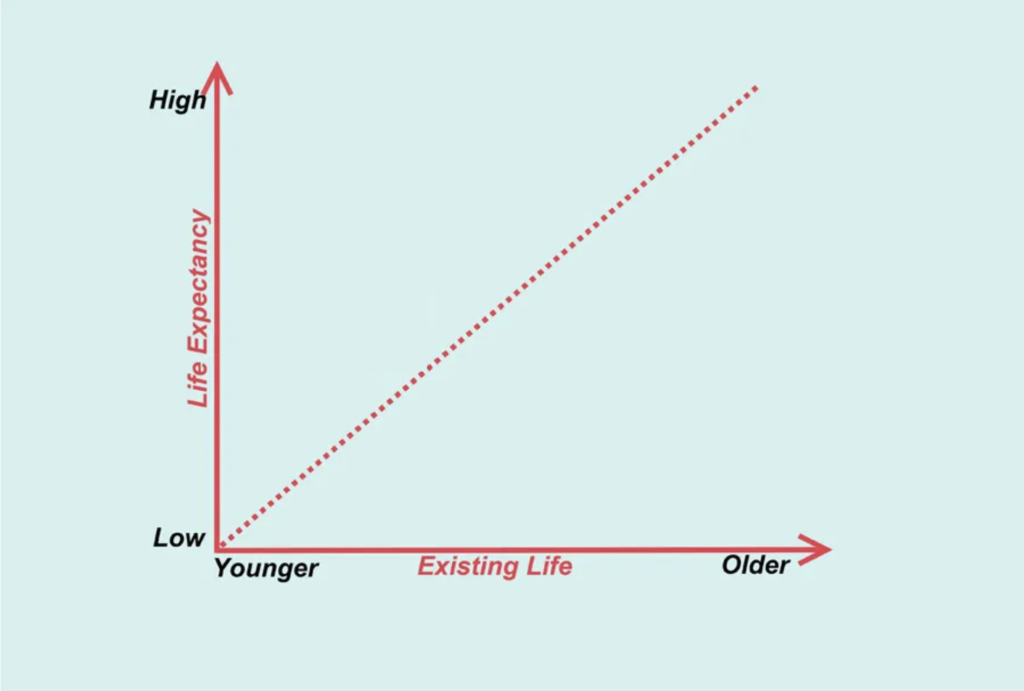
Future life expectancy is proportional to current age. What is more likely to still exist five hundred years from now, the building being constructed in your neighborhood or the Egyptian pyramids? The pyramids of Giza were built over 4500 years ago and are expected to remain standing for several more millennia. The average lifespan of a new building is 50 to 100 years, and according to the Lindy effect, if it surpasses the 100 year mark, it is expected to last at least another 100 years.
The same does not apply to biological life, the older we get, the shorter our life expectancy becomes.
Modern society is built upon and heavily dependent on modern ideas. This type of social and political structure has many weaknesses that, in many respects, have reached a point of no return.
Take the previous example of a new building. If it is built based on modern engineering concepts that are overly complex and have never been tested before, and which, for that reason, require the development of new maintenance practices, it is only a matter of time before its weaknesses become apparent.
The fragility of modern diets becomes apparent when we replace natural foods, to which our digestive system has adapted over millions of years, with synthetic supplements or recent scientific discoveries. The fragility of Artificial Intelligence lies in the fact that it presents itself not merely as a working tool, but as a singular revolution, used to justify the astronomical valuations that tech companies assign to themselves. The fragility of climate policies does not lie in governments attempts to diversify their energy infrastructures, but rather in their acceptance of apocalyptic predictions that lead to the destruction of safe, proven energy sources in order to subsidize “green” technologies, with billions of dollars, that offer no guarantees of sustainability or reliability.
Groups that form around these ideas find themselves isolated from society today due to social media, the homogenization of lifestyles, and social fear. In these contexts, bubbles and echo chambers are created based on beliefs rather than reality.
In the following excerpt from Assata Shakur’s autobiography, she describes one of the moments when she tried to challenge the way the Black Panther Party was becoming complacent toward the weaknesses of its leader, Huey Newton:
“When i said that Huey needed speaking lessons they jumped down my throat. When Huey changed his title from defense minister to the ridiculous-sounding “Supreme Commander” and then to the even more ridiculous “Supreme Servant”, damn near nobody said a word. That was one of the big problems in the Party. Criticism and self-criticism were not encouraged, and the little that was given often was not taken seriously. Constructive criticism and self-criticism are extremely important for any revolutionary organization. Without them, people tend to drown in their mistakes, not learn from them.”
In this book, Assata also discusses the role that the FBI’s COINTELPRO (short for Counter Intelligence Program) played in the party’s dissolution. This was a secret and illegal counterintelligence program conducted by the FBI between 1956 and 1971. Under the direction of J. Edgar Hoover, its main objective was to “expose, disrupt, divert, discredit, or neutralize” the activities and leaders of political movements considered subversive in the United States. Although it began with the Communist Party, the focus quickly shifted to the civil rights movement and militant black groups, including the Black Panther Party and leaders such as Martin Luther King Jr. and Malcolm X.
The tactics used included: infiltration and provocation, involving the placement of informants to create internal conflicts and encourage violent acts that would justify arrests; psychological warfare, through the sending of anonymous letters and fake news to destroy marriages, friendships, and political alliances; assassinations and fabricated arrests, as in the famous cases of Fred Hampton (killed by the FBI and Chicago police while he slept) and the numerous false criminal charges against Assata Shakur herself.
This type of program proves more effective against groups than against individuals, since these organizations have a networked structure with multiple nodes. An attack on one or two key nodes can trigger a chain reaction throughout the entire group. Furthermore, their public visibility is easier to monitor, and their internal vulnerabilities are easier to exploit, given that organizations often have factions or ideological divisions that generate internal disputes. Similarly, legal pressure, interference with funding, and public campaigns immediately affect the organization’s collective resources.
The tactics of the COINTELPRO program were less effective when targeting individuals. These tactics relied on exploiting reputation, social relationships, legal exposure, or psychological stress. Since these actions affect only one person at a time, their impact is less widespread and more costly. While a group gathers at a headquarters or on social media, which facilitates monitoring and control, an individual is more unpredictable and difficult to track in their daily movements. Furthermore, individual harassment is harder to conceal and easier to track. Although threats, surveillance, or smear campaigns can devastingly isolate a person, they rarely go so far as to compromise their entire community.
“Intuitions Come First, Strategic Reasoning Second.”
— Jonathan Haidt
Stereotypically, when a group of men gets together at a bar and moves past the initial pleasantries, three topics of conversation emerge: sports, women, and politics. One of them has a preference for blondes, another is a fan of the Lakers, and another sees no viable alternative to the Republican Party to govern the country. Each passionately defends his ideologies and rationalizes his opinion with facts, however, none acknowledges that he is acting irrationally. The one who likes blondes is, possibly, the most rational of them all. Can’t argue taste.
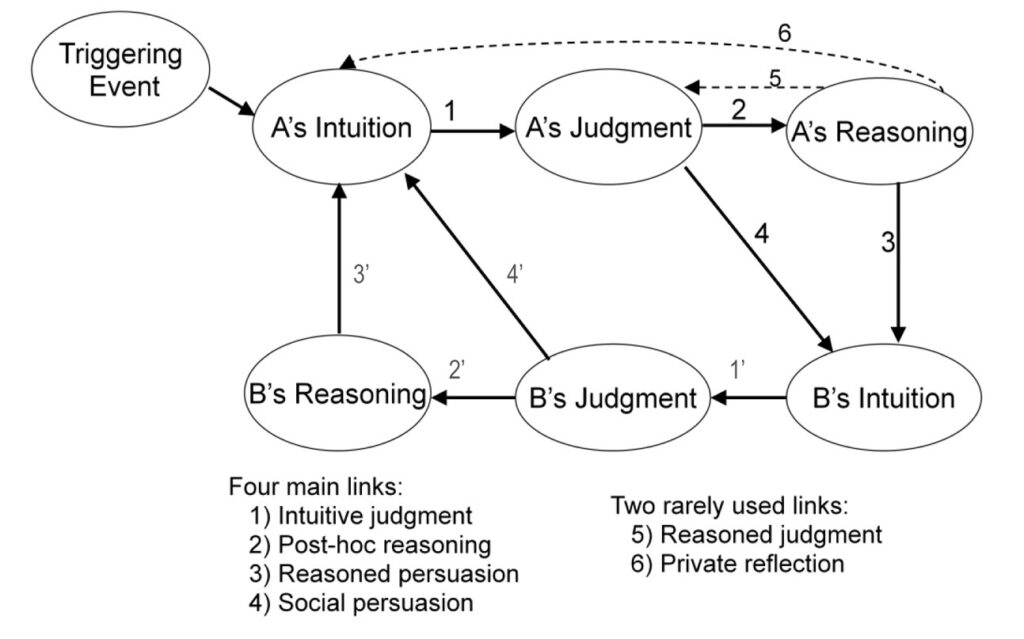
In his book The Righteous Mind, Jonathan Haidt proposed a diagram (image above) showing how our moral judgments actually work in practice, challenging the idea that we are purely logical beings. When something happens, such as an event, our intuition reacts instantly. We immediately sense whether something is right or wrong before we even think about it (link 1). It is only after this judgment that our reasoning begins to work (link 2). The individual does not seek the truth, but rather justifications for what they have already decided.
Since we are influenced by the opinions and arguments of others, the process of reflection does not end here. Social influence (link 4) and rational persuasion (link 3) hijack our judgment process. Links 5 and 6 are dashed because they are rarely used. These represent private reflection and internal judgments that the individual rarely applies, since our reasoning has evolved to be our defense attorney, not an impartial judge. Its job is to find justifications for what we already feel, for our intuition.
“Men, it has been well said, think in herds; it will be seen that they go mad in herds, while they only recover their senses slowly, one by one.”
— Charles Mackay
This model of social intuition explains a great deal about our dependence on group psychology. Charles Mackay, in his 1841 classic, Extraordinary Popular Delusions and the Madness of Crowds, explores how collective psychology can lead to irrational and destructive behavior. The author illustrates how individuals, who are rational on their own, abandon critical thinking and logic when integrated into a crowd. He argues that the human desire to belong to a group and the belief that “so many people cannot be wrong” fuel conformity and collective madness.
The book describes how entire communities suddenly fix their minds on a single object (whether financial gain or religious zeal) and pursue it frantically until a new “madness” captures their attention. This work is divided into three parts: National Delusions, such as economic bubbles; Peculiar Follies, such as the historical obsession with witch hunts or anti-Semitism; and Philosophical Delusions, such as alchemy or prophecies.
The defense mechanisms employed by groups can be observed in nature. Many animals have developed the ability to detect chemical or visual signs of disease and avoid the infected individual. When an animal is raised in isolation or by another species and then attempts to return to its original group or integrate into another group, it may suffer from ostracism or discrimination due to “social illiteracy”, since it is unaware of the codes governing that group.
In 1932, Isaac Deutscher was expelled from the Polish Communist Party following the publication of the article “Danger of Barbarism Over Europe” because the party believed he was exaggerating the dangers of Nazism and spreading panic on the public.
“Jung always quoted the Roman proverb: “Senator bonus vir, senatus bestia!” (One senator is a good man, but the senate is a beast.) One could say that whenever one is in a group, one has to hide one’s best nucleus, or very rarely let it come out. One has to draw a veil over a part of one’s personality because of the automatic lowering of the ethical level.”
— Marie-Louise von Franz
Today, our values reveal an overwhelming tendency toward conformity. In these times, ethics is increasingly identified with obedience. Reaching maturity to overcome the feeling of loneliness and not being classified as a “good person” are only possible when the individual courageously accepts themselves. When parents demand that children be “normal”, they instill values that sacrifice the individual for the sake of the “collective good”.
Courage arises when one ceases to depend on something external to oneself to acquire the strength one needs. The loss of the ‘self’ and its replacement by a ‘pseudo-self’ plunges the individual into an intense state of insecurity, turning him into a social automaton.
Historically, there has been no act of Nazi oppression that was not explained as a defense against the oppression of others. The invasion of Poland was justified as retaliation, just as the start of World War I was justified as revenge for the assassination of Archduke Franz Ferdinand.
Man does not dominate Nature, much less his own nature. The security of feeling like the “master of the World” has been paid for with the inability to manage one’s own life. We are today fertile ground for the spread of extremist ideas, these “weeds” camouflage themselves in common sense, science, health, normality, and public opinion. The claim that problems are too complex to be understood by the average citizen is false. The basic issues of individual and social life are simple, so simple that everyone can understand them. So, if there are weeds, they must be pulled out.
Great content! Keep up the good work!