

In Seeing Like a State, James C. Scott offers a brilliant analysis of modern states. According to the author, the state’s intention is to simplify complex societies in order to make them comprehensible, which often results in social and ecological disasters due to the imposition of top-down orders. The work argues that central planning fails by prioritizing techne (technical knowledge) over mētis (local practical wisdom), citing examples such as scientific forestry and the construction of large cities, typically their capitals, as in the case of Brasília.
In this book, the author identifies and discusses four conditions common to all state planning disasters:
- Administrative Legibility: The state’s attempt to simplify and organize society and nature through maps, censuses, or surnames, to make them easy to monitor and control.
- High Modernist Ideology: A blind and excessive belief in scientific progress, the technical domination of nature, and the rationalization of social order, ignoring historical contexts.
- Authoritarian State: A government with the will and capacity to use its coercive power to impose these planned designs on a population that lacks the means to resist.
- Weak Civil Society: A population unable to organize itself or oppose the state’s plans, often due to wars, crises, or totalitarian regimes.
This work is not intended to explain how state structures function, but rather their intentions and how their ideas emerge. Adam Smith wrote about the Invisible Hand of the Market; James C. Scott wrote about the Invisible Hand of the State.
In the article On Anarchism, I wrote about three anarchic systems that function without central intervention: languages, nature, and technology. To these, I add cities. Our perception is that organizing a city requires central urban planning, the reality is different.
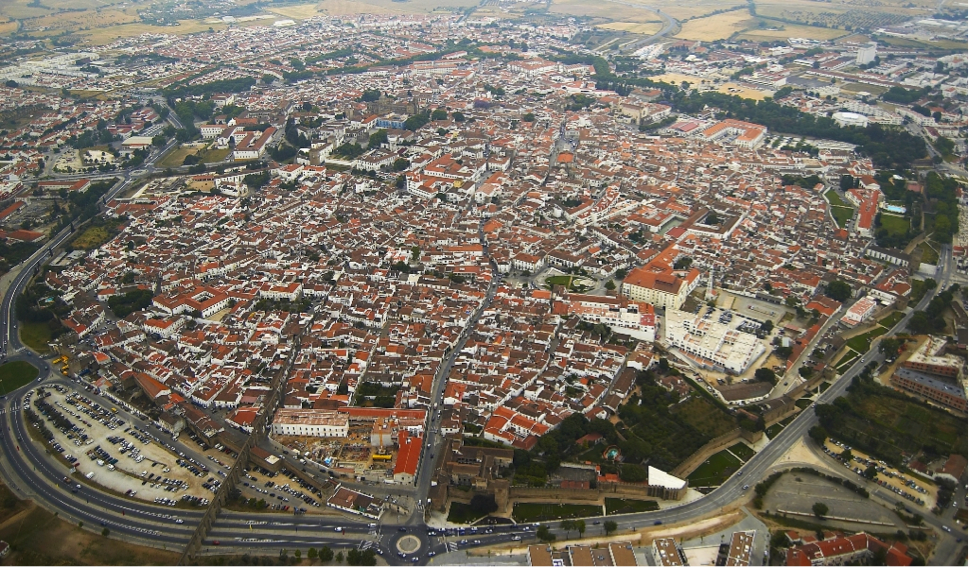

Pre-modern cities, without central planning, grew in rings, similar to a cross-section of a tree trunk. This radially centered structure allowed for the natural growth of its population until it reached the limit of the walls that enclosed it. If there was a need for expansion, a new outer ring of walls was built, creating a structure of successive layers.
This growth in rings ensured that the average distance to the center was minimized for all inhabitants. The streets followed the topography of the land and existing trade routes, resulting in irregular layouts that made sense to those who lived there but were “illegible” to a stranger or to the State.
Modern cities broke with this pattern in favor of straight lines and specialized districts. A grid-based city is much easier to map, police, and tax. The new organization of cities has led to the displacement of their populations to the peripheries.
Brasília, Islamabad, Paris, Chandigarh, Cairo, and Seoul are just a few examples of cities where the rigidity of state-led urban planning, which prioritizes “aesthetics” and “space” over human functionality, ends up pushing the city’s organic life to the margins. Many of these cities, and other capitals around the world, have a lower population density than the cities surrounding them.
“Nothing is so permanent as a temporary government program”
— Milton Friedman
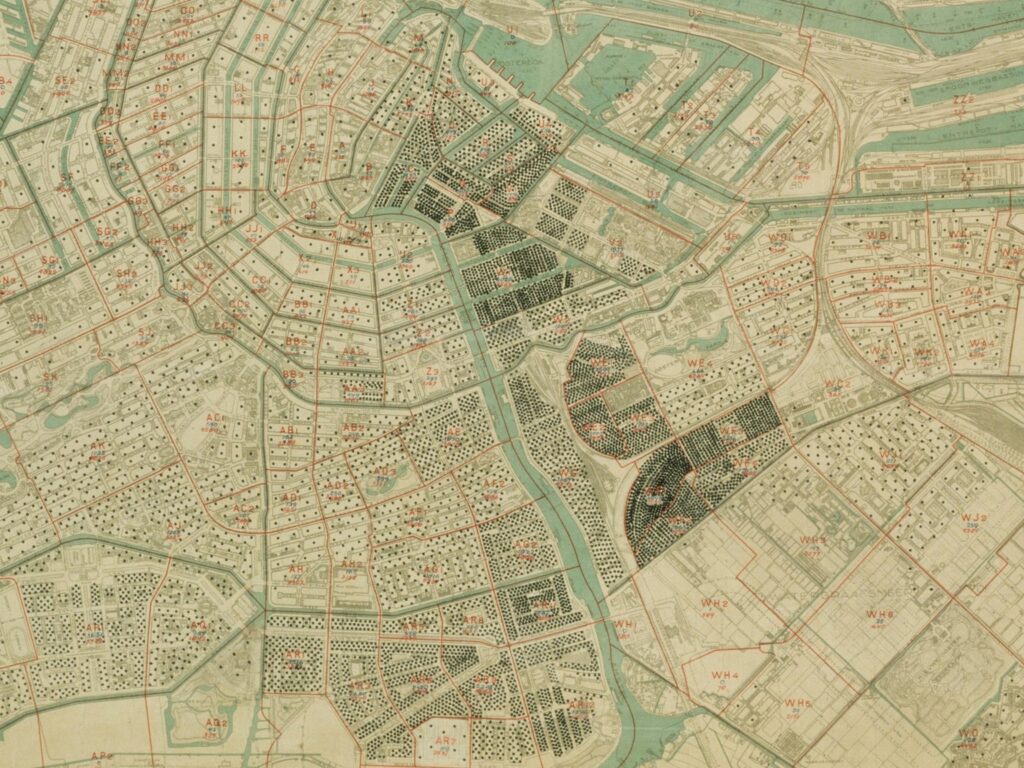
One of the examples cited in James C. Scott’s book regarding the unintended consequences of central planning was the creation of a statistical map showing the distribution of Jews in Amsterdam. This map, titled “The Distribution of Jews in the Municipality,” was produced by the Amsterdam Municipal Statistics Office. Under Nazi occupation, the map was compiled using information previously obtained from population and commercial records, which enabled the systematic deportation of approximately 65,000 Jews.
“Universalist claims seem inherent in the way in which rationalist knowledge is pursued.” “not its recognition of technical knowledge, but its failure to recognize any other.”
— James C. Scott e Blaise Pascal (on rationalism)
In his book Basic Economics, as well as in his other works, Thomas Sowell provides several examples of the state’s inefficiency when it comes to market intervention. In the final years of the Soviet Union, a period when citizens enjoyed relatively greater freedom, two economists, Nikolai Shmelev and Vladimir Popov, wrote a book titled The Turning Point: Revitalizing the Soviet Economy. In this work, they described the weaknesses of their economic system, in which production companies in the Soviet Union ended up constantly asking the government for more resources, since decision-makers did not know exactly what the real needs were. In this type of system, waste carries no economic weight for the company, from the perspective of its production manager.
In addition to financial and material resources, Soviet companies wasted human resources. It was common for a company to have between 5 and 15% more workers than necessary.
“To make one ton of copper we use about 1,000 kilowatt hours of electrical energy, as against 300 in West Germany. To produce one ton of cement we use twice the amount of energy that Japan does.”
— Shmelev e Popov
Economic waste is inherent to the state. In order to monitor, regulate, and tax activities in the free market, the state intervenes to standardize them and make them transparent to the central government, thereby sacrificing the market’s efficiency and organic diversity. The Soviet Union did not lack resources on the contrary, it was one of the richest nations in the world, if not the richest in natural resources. Nor was there a shortage of people with high-level technical education. What it lacked was an economic system that made efficient use of those resources.
“our country – so rich, so talented and so exhausted by incessant experiments”
— Boris Yeltsin
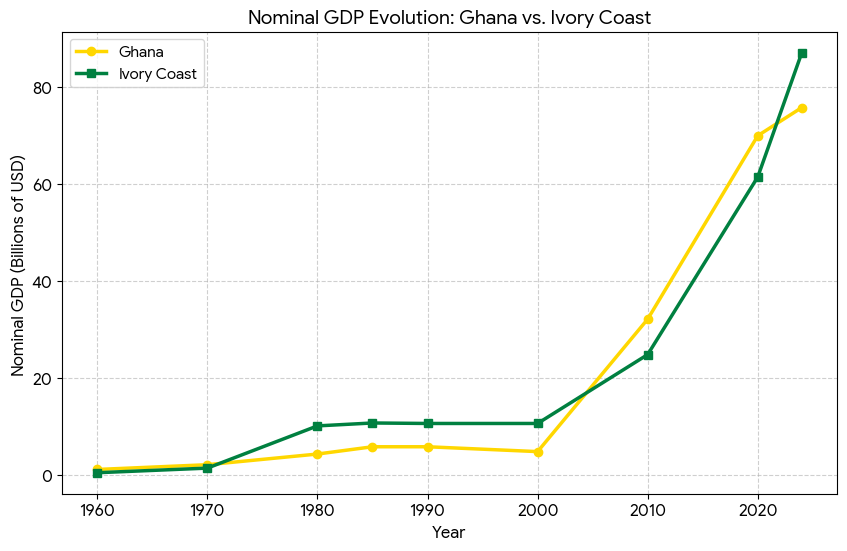
When many African colonies achieved national independence in the 1960s, a famous wager was made between Ghana’s President Kwame Nkrumah and Côte d’Ivoire’s President Félix Houphouët-Boigny over which country would be more prosperous in the years to come. At the time, Ghana was considered one of the most prosperous and promising countries in Sub-Saharan Africa and, compared to Côte d’Ivoire, possessed more natural resources (including gold mines), better infrastructure inherited from the colonial period, a more educated population, higher per capita income, and a booming cocoa industry.
However, the president of Côte d’Ivoire knew that Ghana was committed to a state-controlled economy, while Côte d’Ivoire had a more capitalist market. By 1982, Ivory Coast had surpassed Ghana economically to such an extent that the poorest 20% of its population had a higher real per capita income than the majority of Ghana’s population.
This could not be attributed to any superiority of the country or its people. In fact, in the following years, when the Ivorian government eventually succumbed to the temptation to exert greater control over its country’s economy, while Ghana finally learned from its mistakes and began to relax government controls on the market, the roles of these two countries were reversed. Now Ghana’s economy has begun to grow, while that of Ivory Coast has gone into decline.
In his book Economic Facts and Fallacies, Thomas Sowell raises another point relevant to this discussion: international “aid.” The author notes that international agencies lack the capacity to monitor or control how the money they transfer to these countries is spent. Nor do they have strong incentives to withhold funds that have been used ineffectively, counterproductively, or even corruptly. As such, they rarely publicize the disasters they have financed, as this would call their own institutions into question. It is not surprising that they continued to transfer money to Tanzania during Julius Nyerere’s draconian and disastrous social experiments, to Rwanda during the genocide, or to Saudi Arabia in the 1970s despite its oil wealth. The reason? Monetary expansion and external political power.
“Twelve billion USD hovering over the Gaza Strip / You don’t wanna know what it cost to live / What it cost to hide behind eyelids / When your back turnt, secret cannibals lick they lips”
— Billy Woods
It is difficult to explain, in a seven-page article, all the nuances and consequences of government intervention. Today, according to data from the DGAEP – Department of Administration and Public Employment and INE – National Institute of Statistics, more than 759,000 employees work directly in the civil service. This figure represents about 15% of the employed population. If we include workers with indirect ties, such as those in outsourced companies (gardening, cleaning, or security), jobs created in the construction industry through public tenders, or employees of municipal companies, the total rises to about 1.15 million. When we add heavily subsidized industries, such as agriculture, fisheries, defense, and the publicly funded healthcare sector, the actual number reaches 1.6 million workers: one in every three members of the working-age population.
The problem? Since the policies imposed by the government do not result from voluntary transactions, such as those in the free market, these zero-sum, or even negative-sum, operations can continue indefinitely. The tax burden required to sustain these decisions and the weight of public debt are suffocating the private productive sector, forcing future generations to finance a bloated state apparatus that the market alone would never be able to sustain.