
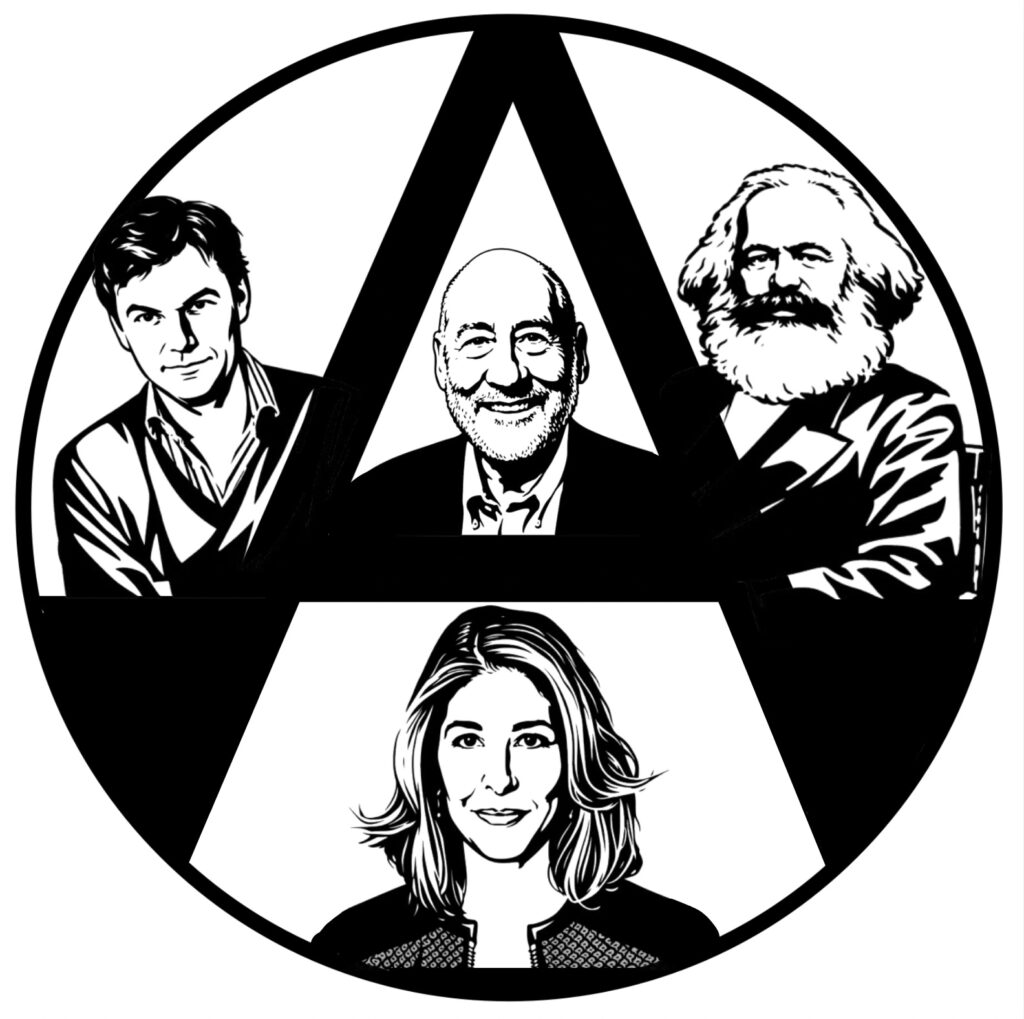
“What the advertiser needs to know is not what is right about the product but what is wrong about the buyer.”
— Neil Postman
Capitalism is an economic system based on private ownership of the means of production, wage labor, and the pursuit of profit, where the market regulates production and prices through the law of supply and demand. It evolved from mercantilism, in which the state exercised total control, establishing monopolies and protecting the domestic market with high tariffs.
For me, the definition of capitalism is simply the voluntary individual management of capital. This capital can take many forms, as discussed in the article On Capital.
Several authors, from politicians to renowned economists, have attempted to define capitalism and its place in society. Due in large part to their academic backgrounds or professional experiences, most have only managed to define part of what it represents. The spread of preconceived ideas on this topic has allowed the word to be transformed into something more, or perhaps something less.
In Capital, Karl Marx conducts an exhaustive and critical analysis of the capitalist mode of production. Originally published in 1867, the book seeks to uncover the economic laws that govern modern society, focusing on the relationship between capital and labor.
Marx begins the book by distinguishing between the capitalist and the worker. The author argues that the relationship between the capitalist and the worker is defined by structural inequality and conflict of interest, centered on exploitation and the appropriation of surplus value. Since the worker does not own the means of production, he is “forced” to sell his only property, his labor power, in exchange for a wage. According to Marx, this “exploitation” occurs because the worker produces more value than he receives in the form of wages.
Before investing, capitalists need to conduct market research and prospecting studies, create a business plan, assess opportunity costs, and define risks. Even after investing, they need to focus on their coordination and problem-solving functions. This also makes them workers. On the other hand, if workers accumulate financial capital, the money they earn, and intellectual capital, such as the technical knowledge they obtain in the course of their work, why can’t they call themselves capitalists? If they are part of the active process of capital creation and are part of the capitalist system, they are also capitalists.
The author argues that surplus labor produces extra value, or surplus value, which is appropriated by the capitalist to accumulate wealth. When reading Karl Marx’s works, it is difficult to determine whether the author intends to criticize or merely describe the systems he addresses. The criticism exists only in the adjectives he uses and the points he omits. This surplus value is the mitigation of the risks that the capitalist incurs in the act of investment, in the tools of production, and in the facilities he builds.
When we buy something like a house, a car, or even something as simple as an item of clothing, we participate in this process of assessing “added value.” For someone who does not need to buy an item of clothing, a leather jacket that costs €120 not only does not justify the investment, but they would not be willing to pay even a third of the price for it. But for someone who replaces their car with an electric car, since they can recoup its price after 10 years by saving on fuel purchases, this added value is what makes the buyer participate in this exchange system.
In the modern economy, value is not crystallized within the object through labor, as Marx claims, it is subjective. A bottle of water in the desert is much more valuable than an identical one five meters from a water source. The value of our work comes from demand and not from the time spent by the worker. If I spend three months working on a cabinet of poorer quality than one built in a mass production unit, the value I give to both is irrelevant; it is the market and its demand that define it.
Fortunately, Marx’s catastrophic predictions did not come true as he described. According to the author, the impoverishment of the working class caused by capitalism would lead to the growing misery of workers. However, in developed capitalist economies, the standard of living and real wages of the working class increased significantly throughout the 20th century. In these societies, an individual belonging to the low-income class has better living conditions than a king 100 years ago.
Outside the concept of poverty of spirit, economic poverty is not just a matter of numbers in a bank account, but rather a relative and psychological experience. It is a social measure.
“My parents did just well enough so that I could grow up poor around white people… everybody in the projects is poor, and that is fair. But if you were poor in Silver Spring, it felt like it was only happening to you.”
— Dave Chappelle
In books such as Factfulness by Hans Rosling and Enlightenment Now by Steven Pinker, the authors demonstrate how, over the last 200 years, the percentage of the world’s population living in extreme poverty has fallen from around 90% to less than 10%. Economic growth generated by capital accumulation and global trade has enabled billions of people to escape subsistence living.
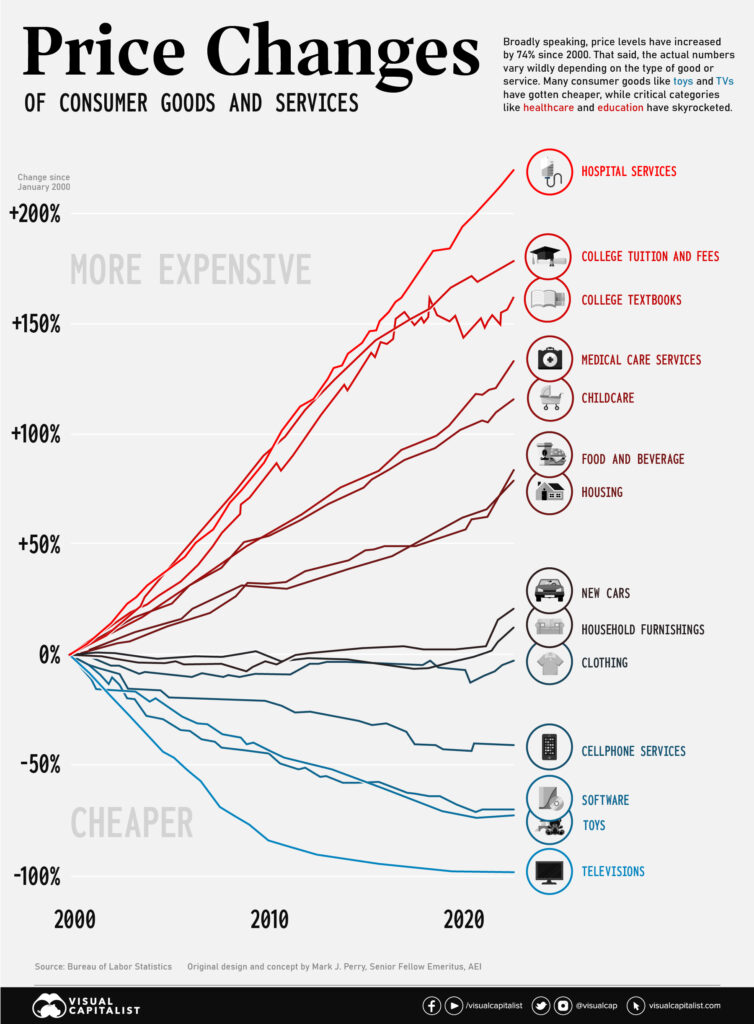
The incentive for profit acts as fuel for technological progress. The competition that the free market fosters among companies allows for the production of better and cheaper products. There is a reason why the most deregulated industries, whose conditions resemble ideal free market conditions, such as the high-tech industry, allow for deflation in the price of their products, despite the inflationary regime we are currently experiencing. The graph shows this price variation, with industries with greater state intervention or regulation showing the largest increases.
The capitalist system consists of a network of price signals that prevents the waste of resources. If a resource is scarce, the price rises, forcing society to find alternatives or use that resource more efficiently. This creates an optimization that systems without market prices cannot replicate. If, the next time you go shopping, apples are priced at 10 euros per kilo and pears at 2 euros per kilo, despite your preference for apples, you will end up buying pears if the investment is not justified. If, in the coming days, most people share your sentiment, there will be a drop in stock and the retailer will be forced to lower the price of apples until a new adjusted price is found. The reverse also occurs: if demand for a product is high, the price rises to compensate for this demand. This signal is interpreted by producers as an opportunity for profit, so increased production supplies the market until supply exceeds demand, putting pressure on prices to fall again.
Social mobility, individual freedom, and global life expectancy, which was around 30 years at the beginning of the 19th century and now exceeds 70 years, are other benefits that the capitalist system has brought to today’s society.
Despite these benefits, criticism of this system prevails. It is rooted not only in the social structure, but also in public institutions.
Thomas Piketty is a French economist, born in 1971, widely recognized as one of the world’s leading experts on the study of economic inequality. Often called the “modern Marx,” his main thesis is that capital income grows faster than the economy, which inevitably leads to the concentration of wealth. The author isolates financial capital, leaving aside its political impact on social and economic relations throughout history.
In the article On Crime, I wrote about the impact Richard Nixon had on the world with the decisions he made during his presidency. One of them was when, in 1971, the dollar ceased to be linked to gold through the gold standard, which allowed the United States full autonomy in setting its monetary policy. The expansion and contraction of the money supply, i.e., the number of dollars circulating in the economy, created by this new autonomy, allowed the US, and consequently other countries, to erode the purchasing power of their citizens by devaluing their currency. The power to “print” money without limit distorted market signals. The rampant inflation and credit expansion that these measures created benefited those close to the “printer” (banks and large corporations) before the money reached the rest of the economy. This is called the Cantillon Effect.
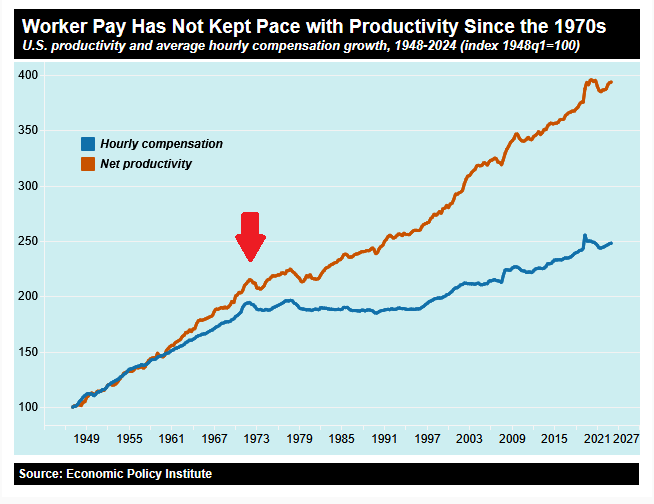
In that same article, I mentioned the website https://wtfhappenedin1971.com/. I do so again here to show a graph where you can see the point at which wages decoupled from economic productivity.
Naomi Klein is one of the most influential critics of contemporary capitalism, but her perspective is often pointed out by market economists as having flaws similar to those of Marx, especially in the way she interprets the relationship between the economic system and social or environmental crises.
In her book on the climate crisis, Klein argues that capitalism and the planet are at war and that the market system is incompatible with ecological survival. The author argues that neoliberalism advances by taking advantage of disasters (wars, crises, or natural catastrophes) to impose reforms that the population would not accept in normal times.
Klein sees capital as a force that “devours” people, nature, and its resources in order to expand, yet there are two emerging economies that contradict this view.
In the following NASA satellite image, it is possible to observe the variation in global leaf area (the so-called “greening” of the Earth) between 2000 and 2017. This means that the green area on the planet has increased by 550 million hectares in the last two decades, which is equivalent to the area of the Amazon Rainforest. One-third of this achievement is a contribution from China and India. Who would have thought?

CO2 emissions, one of the main greenhouse gases, resulting from heavy industrial production in these countries, have boosted food production, which has reduced the number of people going hungry. It is an inconvenient truth for many, but CO2 emissions also reflect prosperity.
Many critics of the capitalist system end up making moral judgments without a complete understanding of how it works. Generally, their criticisms lack rigorous definition and reasoning, stemming from emotional reactions and preconceived ideas. They do not seek evidence to test theories, they seek facts to confirm them.
What do these authors, journalists, and professors have in common?
They have never worked in the private sector.
How is it that the most popular ideas about capitalism come from authors who have never participated in the system, except as consumers?
Marx never worked in a private company in the modern sense. He was a newspaper writer and editor and lived most of his life in serious financial difficulty, supported by his friend Friedrich Engels. Piketty’s career has been strictly academic and consultative. Klein is a public intellectual whose career is based on communication and “activism.” Once again, a journalist and, currently, a teacher. Incredible!
The capitalist system is a gigantic decentralized information processing system. Its benefits are evident, its harms are residual, when understood in its entirety and operating in a free market.
James Baldwin wrote:
“Love is expensive. One must put furniture around it, or it goes.”
Preconceived ideas are also expensive. And in this case, those who have them fill their furniture with books until they can no longer see reality.