The word capital derives from the Latin capitālis (“relating to the head”), which in turn comes from caput (“head”). Its use dates back to Classical Antiquity and Prehistory, times when a person’s wealth was measured by the number of head of cattle they owned. Cattle were one of the first and most fundamental assets in human history. They allowed extra value to be produced through milk, meat, labor, offspring, or transportation. The adjective capitālis reinforces this idea, meaning “that which is above others, principal, or dominant.”
During the Renaissance, Italian bankers began to use capitale to designate the main part of an invested amount, a concept that evolved in the 19th century into the economic definition of goods and wealth. With the development of political economy and works such as Karl Marx’s Capital, the word took on the meaning of “wealth as a means of production,” as opposed to “labor,” or “money that generates money.”
Today, it refers to the set of accumulated assets or resources that are used to produce new goods or services. It is not limited to money, but includes all assets that generate value. “We don’t talk about politics or money at the table,” because someone has already capitalized on the situation. If financial and political illiteracy is a current problem, associating this word only with money is a capital offense.
The way we organize society today is heavily influenced by state authority, a practical example of which is the introduction of monocultures. These modern agricultural practices emerged as a tool for social and fiscal control. Their implementation facilitates the supervision of farms and allows for administrative simplification. It is easier to tax a farmer who grows a monoculture of raspberries on 20 hectares than one who grows 80 different species in the same area.
In the short term, the biological capital of the farmer who grows raspberries is likely to be higher than that of the farmer with 80 species, due to the current value of this fruit. However, the long-term value of their farm is lower. Monocultures interact with the soil through a process of ecological simplification that depletes it of nutrients. In addition to this selective depletion of nutrients, they degrade its physical structure and cause a reduction in the biodiversity of microorganisms. To compensate for this deficiency, farmers need to spend resources on purchasing compounds and fertilizers to chemically correct the soil. Added to these problems are greater vulnerability to pests, extreme weather conditions, excessive dependence on the success of a single crop, and the conversion of agricultural practice into a purely seasonal economic activity.
Capital is accumulated over a long period of time. Decisions made solely to obtain short-term gains ultimately destroy this acquired capital.
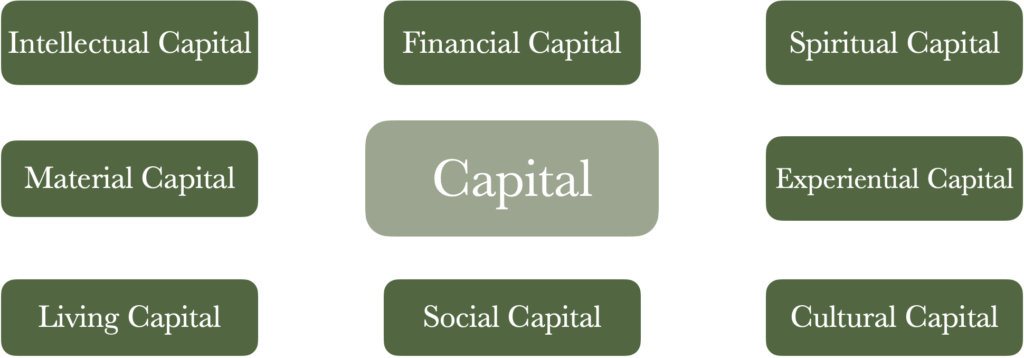
A few years ago, I became interested in the principles of regenerative agriculture and permaculture agricultural planning. In the process, I came across an article titled “Eight Forms of Capital” by Ethan C Roland. In it, the author redefines the current financial system based on the principles of permaculture presented in chapter 14, “Strategies for an Alternative Nation,” from Bill Mollison’s book Permaculture: A Manual for Designers. How would this system work if it operated like an ecosystem?
“If only fit where the rich sit, I’d be in poor standing.”
—KA
Financial capital is the most immediate form in people’s minds, the one we associate with the word. It describes the various forms of money, currencies, assets, securities, or other financial instruments. Many books attempt to explain the historical evolution of this type of capital and how it adapts to the structures of our society. Of all those I have read on this topic, Broken Money, by Lyn Alden, is the most comprehensive. From its earliest use, through stones and shells, to today’s banking and monetary systems, the author explores the history of money through its technological evolution.
“I need money, not for trivial material / Just to fix our flaws, the whole cause is ethereal / What you minin’ for? If unaware share with blind and poor / You tellin’ stories that’s celebratory in times of war / With bars of greed, I plead, how many cars you need?”
—KA
Material capital is the most direct and, at the same time, most artificial extension of financial capital. It describes physical objects that have been acquired or developed. However, not all objects are a good representation of material capital.
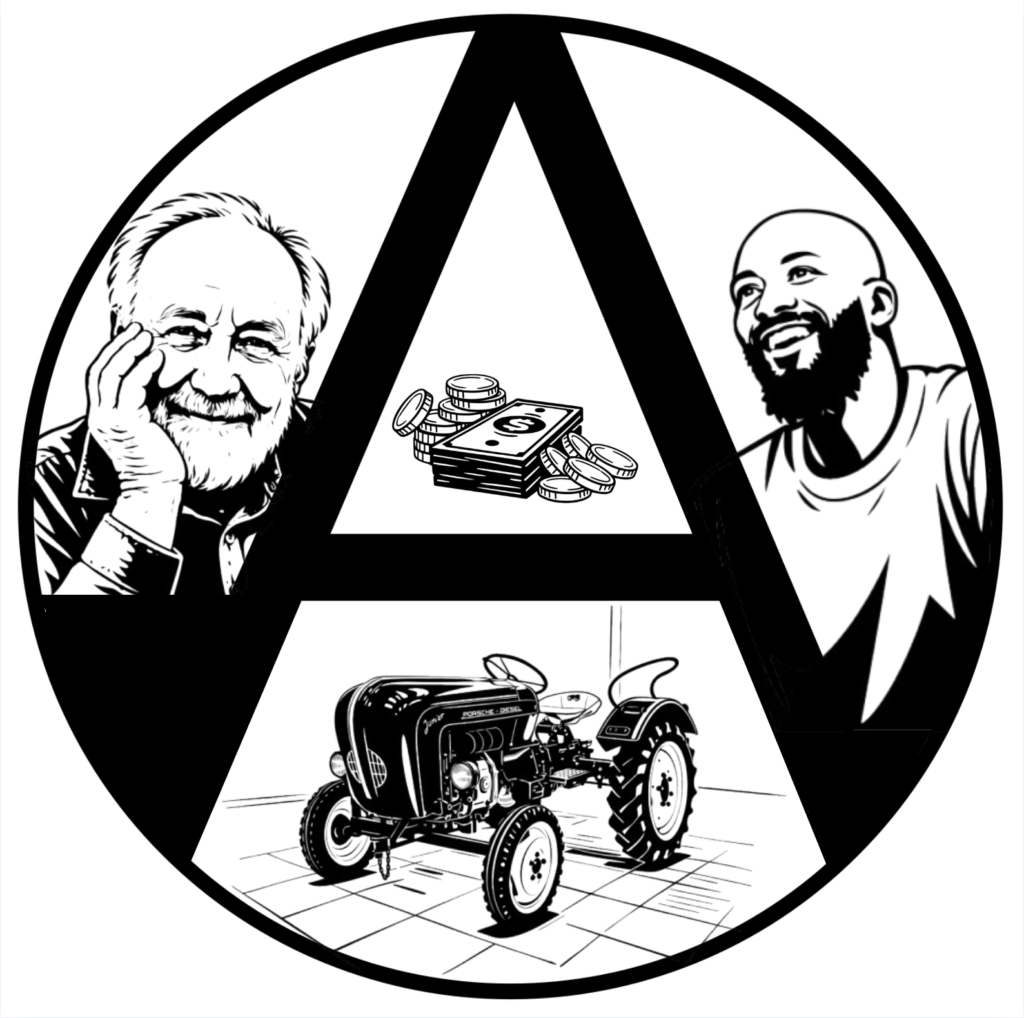
If tomorrow, a man going through a midlife crisis walks into a Porsche dealership and buys a car to impress his neighbors, he has increased his material capital but decreased his financial capital. This asset depreciates as soon as it leaves the dealership, has maintenance costs, and requires fuel to run.
However, if 70 years ago his great-grandfather went to that same dealership and bought a tractor, the logic would be reversed. Not only would he be acquiring an asset that does not depreciate at the same rate, due to its utilitarian nature, but he would also be acquiring a work tool. That tractor would allow him to increase the productivity of his land, converting material capital into more financial capital through agricultural production. Today, that same tractor, as a collector’s item, would have preserved or even multiplied the capital invested, proving that material capital is only valuable when it enhances the creation of new resources rather than consuming existing ones.
“Funny used to call my friends money, I lost hundreds”
—KA
It’s not the number of friends you have that matters, but those you can count on.
Your social capital is not limited to the number of followers you have on Instagram, but how many would help you in a pinch. In politics or in the world of work, sometimes the most important thing is not what you know, but who you know. Your skills and qualities only take you so far. Usually, the employee closest to the boss is the one with whom they have the best social relationship, not the one who produces the most or has the most skills.
“They deeds disease the seeds, I produce produce”
—KA
Living capital is most relevant in agriculture, which includes animals, plants, water, soil, and land, and forms the basis of life on the planet. It is the only type of capital that has regenerative capacities.
We humans are also part of living capital. Our health, reproductive capacity, and physical availability are extremely important for the ecosystems we are part of and for those who depend on us. We are only what our bodies allow us to do.
“Motives too ill to build, helped demolish / Till I realized wealthy is health and knowledge”
—KA
The knowledge that each person possesses and has acquired throughout their life is our intellectual capital. The ability that each person has to transform our knowledge and apply it in everyday situations is our experiential or human capital. It represents the practical part of intellectual capital, such as organizing a project, repairing a bicycle, or using theoretical knowledge to develop practical skills.
“Hope the sacrifice match the vice / Speak thoughts sincere to spare the soul / I pray every cross you bear is gold”
—KA
Spiritual capital contains aspects of intellectual and human capital, but it is more personal and less quantifiable. Even if someone does not identify with any religion, considers themselves agnostic or atheist, they still possess this form of capital. What we believe in is different from what affects us. The way we deal with or reflect on the adversities we face or the good fortune we enjoy is a reflection of our spiritual capacity.
Two people may have exactly the same daily routine, yet experience it in different ways. The start of the day may include waking up early, making breakfast for the children, taking them to school, and driving to work. For one person, it is a burden to have to organize all these activities before going to work, dealing with city traffic and listening to the children screaming on the way. For the other, it is a blessing to be able to feed their children, share this time with them, and, resigned to the traffic, take the opportunity to listen to their favorite music. These small differences in spiritual capital that both possess make a difference at the end of the day. They turn a bad day into a normal day, a normal day into a good day, or an exhausting day into a productive day.
“Can’t afford to have one wasted or fall through / ‘Cause if one make it, we all do / Success is by committee, never all you”
—KA
Cultural capital describes the internal and external processes of a community; it is the only type of capital that cannot be accumulated by an individual. It is seen as an emergent property of a complex system of internal capital exchanges in a location, such as a village, city, region, or nation.
“These seconds, these minutes are ours (hours)”
— KA
To these eight forms of capital, I add time. Time is a dimension, a resource, capital. It interacts with financial and intellectual capital, forming a trilemma.
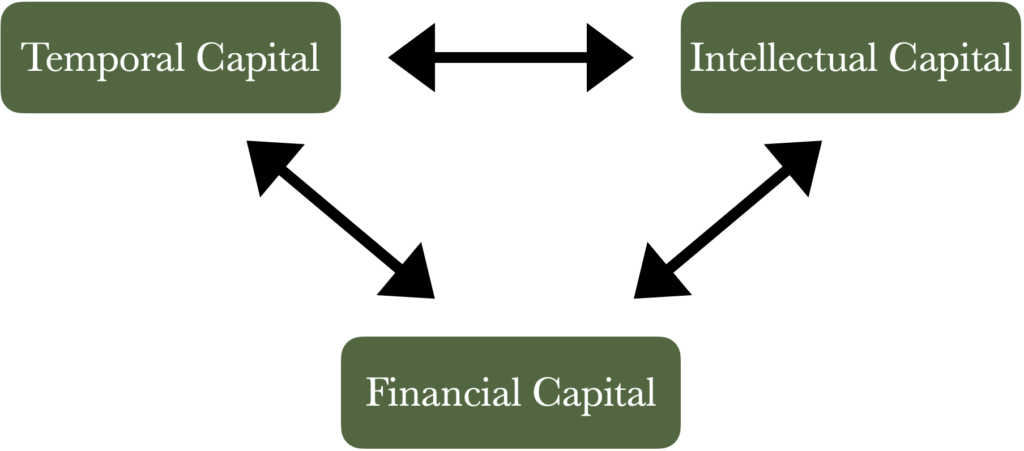
To gain knowledge, you need to devote time to learning and money to finance a course, training, or tutor. If you need free time, you pay to delegate tasks and apply your knowledge to optimize processes. If you need money, you apply your knowledge and time by providing your services.
The concept of dividing capital into several parts is common in other cultures. In yoga, the Pancha Koshas (five “sheaths” or layers of human existence) function as an internal capital system. These represent Annamaya Kosha (physical body), Pranamaya Kosha (energetic body), Manomaya Kosha (mental body), Vijnanamaya Kosha (intellectual body), and Anandamaya Kosha (body of bliss).
Other ancient cultures and philosophies of well-being use “multiple capital” systems that reject the idea that wealth is only financial. From the Maori to the Andean peoples to ancient Greece, all divided capital into several categories.
In 1972, Bhutan replaced GDP (Gross Domestic Product) with Gross National Happiness (GNH), an index that divides national “capital” into four fundamental pillars:
- Sustainable Socioeconomic Development: (Material/Financial Capital);
- Cultural Preservation: (Cultural Capital);
- Environmental Conservation: (Living Capital);
- Good Governance: (Social/Institutional Capital).
A few days ago, after months of tension and nuclear negotiations mediated by Oman that ended in a stalemate, U.S. and Israeli forces launched an offensive against Iran. War is one of the most devastating events in terms of capital destruction, a veritable “black hole” that consumes its multiple forms.
Without the proper context, it may seem insensitive to talk about capital when discussing the subject of war, but when the word is properly contextualized, it allows for the correct framing. The annihilation of financial and material capital is the least of our problems in the face of the loss of living and cultural capital. When our governments choose to put the lives of their citizens at risk or destroy entire communities, it is of capital importance to oppose these decisions.