Everyone has a different definition of the meaning of life. The development of self-awareness in human beings has led us to obsess over this philosophical question. “What is the meaning of life to you?” is repeatedly the question that closes interviews with well-known personalities, writers, or philosophers.
It is curious to hear their answers. Many are linked to personal happiness, making the most of the moment “carpe diem”, loving or being creative. Others define the meaning of life as a challenge, fulfilling ethical, moral and religious duties, or contributing to society.
These answers fall into two types: the group of internal experiences, for the former answers, and the group of external experiences, for the latter. At times there is overlap. Starting a family, for example, can be interpreted as an external experience, represented by procreation and the continuation of the species, or as an internal one, since it involves deep emotions and the creation of interpersonal bonds.
Neutral stances such as nihilism or absurdism are the least common types of answers in these interviews, unless the interviewee wishes to end the conversation on a fatalistic note.
To truly understand the meaning of life, one must encompass the totality of existence. We should not exclude groups of people who cannot, or do not have the opportunity to experience life as we do. Human beings who live with mental or physical disabilities observe a different reality. A person with visual impairment or blindness may show greater auditory or tactile sensitivity. Even if they cannot contemplate a majestic mountain or appreciate a beautiful painting, they internalize and process stimuli that others are unable to perceive.
A child growing up in a conflict zone or a totalitarian regime will be unable to travel or experience new cultures in the near future, much like someone who lacks the economic means to do so. About two hundred years ago, some of these “meanings of life” would not have been possible. Extensive travel only became common with the commercialization of steamships and steam train crossings in the early nineteenth century.
What purpose would productivity and creativity serve for someone born into slavery, or for the zek who labored for decades in a gulag on a daily ration of just a few scraps of bread, until he finally lies in the bed made for him by exhaustion or death.
Using these “meanings of life” as a mantra can provide purpose, but it can also push things to the extreme. Some people commit acts of extreme danger to test the limits of life.
These people are addicted to adrenaline and seek experiences that activate that hormonal circuit. Such acts hijack the dopaminergic reward system, which within a few hours moves from a state of euphoria to a phase of peace and serenity and, when dopamine levels fall below baseline, culminates in a feeling of emptiness and the desire to repeat the radical act.
A system that was designed to reinforce behaviors that increase the probability of survival is now highly susceptible to drugs, gambling, social networks, extreme risk, and pornography. It creates a feedback loop triggered by artificial stimuli that desensitize and fuel self-destructive behavior.
The commercialization of products that exploit the vulnerabilities of this system has grown multibillion-dollar companies, such as Facebook, where employees have publicly disclosed some of the strategies implemented by the company to take advantage of its users, or Red Bull, which sponsors athletes who compete in sports with the highest mortality rates. Red Bull gives you wings, literally.
“… the free climbers. What’s happening during the experience? I’m totally present, I’m one with life, I’m grounded, I’m totally focused, I’m fully alive. Why? Because it triggers the dopamine in their brain.”
— Gabor Maté
We all live under different conditions and realities. Each person deals with life in their own way, but the key word here is “life,” and we are not the only living species.
The concept of the meaning of life is not limited to human beings, it encompasses all life. Not only animals, plants, and fungi, but also unicellular organisms.
“If a lion could speak, we could not understand him”
— Ludwig Wittgenstein
If there were a point at which to abandon this article, I fear we have reached it. To get to the bottom of this question it is necessary to enter the realm of metaphysics and move beyond intentionality, experience, or purpose, as these are not qualities that all living beings possess.
We are part of an ecosystem that transcends our existence. Life existed for millions of years before us and will continue to exist after the extinction of our species.
What meaning of life suits a plant or a fox? What experiences do we identify in nature?
Bees pollinate plants, which grow and offer shade and food to animals. Trees are transformers of water and carbon dioxide. The beaver cuts them down to create its habitat, we use them as raw material, the giraffe consumes its leaves, the deer feeds on the grasses. The lion kills its prey, the mosquito consumes nectar, recycles organic matter and nutrients in aquatic ecosystems, that ultimately fertilizes the plants. There is a cycle of balance and adjustments.
All animals have their own external and internal experiences, but these are biological actions and functions, not a meaning of life. They are nature, they are instincts, we are cogs in a global system.
In the prologue of his book Feeling and Knowing: Making Minds Conscious, the Portuguese neuroscientist António Damásio defines the purpose of life:
“homeostasis was assisted by newly evolved coordinating devices known as nervous systems… Gradually, over a few hundred million years, homeostasis began to be partly governed by minds… Feelings, on the one hand, and creative reasoning, on the other, came to play important parts in the new level of governance that consciousness allowed. The developments amplified the purpose of life: survival.”
— António Damásio
Survival. It is the most elegant and the simplest solution to our question.
This Darwinian view is still often rejected by contemporary society, as it appears to be reductionist. It escapes the idea of purpose instilled in us by religions, cultures, and moral philosophies. It demystifies comforting myths and illusions.
“What I want to earn from this journey is to arrive at my peak / Assess more goals for myself, like surviving is weak”
— KA
We learned to defend ourselves against predators, developed communities and domesticated nature and wildlife. We formed complex societies through technological evolution and laws. We created large-scale production with the Industrial Revolution and addressed its limitations with modern science and digital technology. At the same time, we distanced ourselves from what formed and created us, Nature. We developed the ego and felt superior to other living beings, as if we are more than life itself. We seek purposes, objectives, goals to be fulfilled. Survival is not enough, it does not nourish fragile souls.
No matter how technical and evolved we wish to appear, with more than three hundred thousand years of evolution, we continue to find problems to solve. Artificial solutions to artificial problems, survival is in the truck of the car being driven by human curiosity.
In the epilogue of the same book, António Damásio speaks of these problems:
“We need to respect the phenomenal and incompletely understood intelligence and designs of nature itself… Behind the harmony or horror that we recognize in great art created by human intelligence and sensibility, there are related feelings of well-being, pleasure, suffering, and pain… Acknowledging priorities and recognizing interdependence may come in handy as we cope with the ravages that we humans have inflicted on the earth and on its life, ravages that are likely responsible for some of the catastrophes we currently face, climate changes and pandemics being two prominent examples. It will give us an additional incentive to listen to the voices of those who dedicate their lives to thinking through the large-scale problems we face and recommend solutions that are wise, ethical, practical, and compatible with the big biological stage that humans occupy. There is some hope after all, and perhaps there should be some optimism as well.”
— António Damásio
Although I agree with the author regarding our impact on planet Earth, I disagree with the scope and degree of protagonism that human activity had in creating these problems. António Damásio, representing the established scientific community, could not fail to adopt the consensual position that human beings are to blame for all the world’s ills.
These words illustrate yet another symptom of the human need to act, to impact the world, to leave a fingerprint. Often the best solution is no solution, non-intervention.
“People walking around all day long, every minute of the day, worried about everything! Worried about the air; worried about the water; worried about the soil… worried about saving endangered species… Saving endangered species is just one more arrogant attempt by humans to control nature. It’s arrogant meddling; it’s what got us in trouble in the first place. Doesn’t anybody understand that? Interfering with nature. Over 90%, WAY over 90% of all the species that have ever lived on this planet, ever lived, are gone! Pwwt! They’re extinct! We didn’t kill them all. They just disappeared. That’s what nature does… Let them go gracefully. Leave nature alone. Haven’t we done enough? We’re so self-important.”
— George Carlin
In 2020, Netflix released a documentary titled A Life on Our Planet, narrated by David Attenborough. In this documentary, David Attenborough reflects on his career and his personal life, showing the environmental changes he has witnessed. Focused on issues of environmental destruction, biodiversity conservation, and hope for the future of the human species, the documentary opens and closes with footage of the current conditions of the Ukrainian city of Chernobyl. Evacuated after the nuclear disaster, the images show how, in less than 40 years, the city was reclaimed by nature.
The documentary ends with David Attenborough’s proposal for the problem of the human species continuity:
“There are many differences between humans and the rest of the species on earth, but one that has been expressed is that we alone are able to imagine the future. For a long time, I, and perhaps you, have dreaded that future, but now, it’s becoming apparent that it’s not all doom and gloom. There’s a chance for us to make amends, to complete our journey of development, managе our impact, and once again become a spеcies in balance with nature. All we need is the will to do so. We now have the opportunity to create the perfect home for ourselves and restore the rich, healthy, and wonderful world that we inherited. Just imagine that.”
— David Attenborough
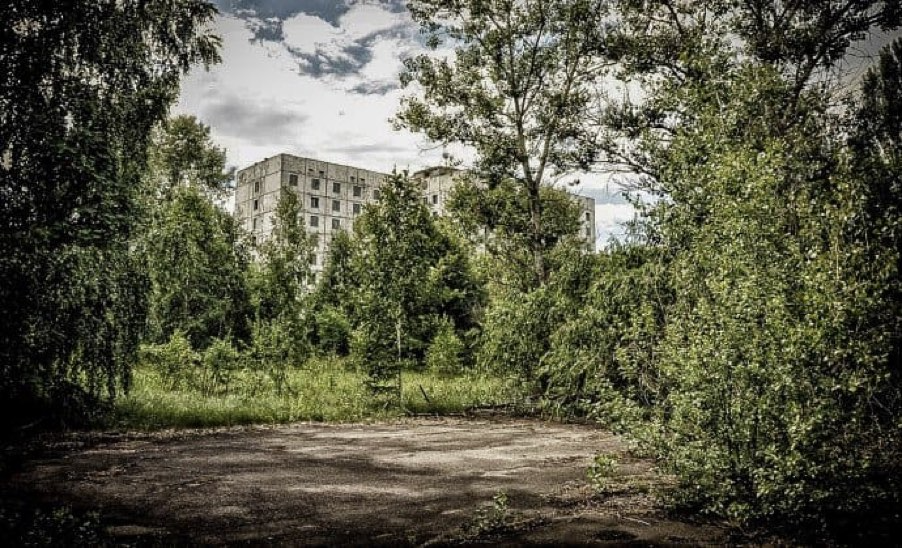
Building surrounded by wild forest in Pripyat
“Imagine the future,” “manage our impact,” “we now have the opportunity to create the perfect home for ourselves”. This vision is not the solution to our problems, this vision is what created them!
“You are the victim of men who think they are right”
— Merry Christmas Mr. Lawrence
Survival is enough. Not only is it enough, it is the meaning of life. The complexity of our species, relative to others, does not make us superior, it merely offers us more choices and presents us with more lifestyles. This view is not simplistic or reductive, on the contrary, it is inclusive. It is a mistake to think that other people are less than us just because they do not share the same daily routines or perspectives on life. It is discriminatory, it is divisive, it is the opposite of life.
The behaviors of the animal kingdom, shaped by evolutionary mechanisms and biological predispositions, contribute to maintaining the balance of the ecosystems in which these species exist. To ensure this balance, we must learn the lessons nature teaches us. Our freedom ends where it interferes with the freedom of others. The planning and modeling of potential events not only mortgage the future of present generations, but also limit and impose upon the freedom of future generations.
Help those who ask for it, not those who struggle. Struggles are temporary, the damage and consequences of our actions are permanent.
Norm MacDonald finds an old school friend, who was a genius in his youth, working in a SeaWorld feeding baby dolphins.
“I’m ashamed of you, Jacques DeGatineau,” Norm said. “You could’ve done so many great things.”
“Well,” Jacques responded, “I think I’m serving a youthful porpoise.”