“Before we are born, we live for an eternity, after death, we shall live eternally.”
— Some philosopher, probably.
Last year saw the release of the highly anticipated Clipse album, ‘Let God Sort Em Out’. Rappers Pusha T and Malice decided to open the album with a track dedicated to their parents, who passed away just four months apart. Featuring John Legend and Stevie Wonder, and produced by Pharrell Williams, the song took many by surprise. Known for their verses about the streets and drugs, no one expected to hear them speak about an experience as personal as recounting the final conversations they had with their parents. It was the first time they presented themselves, artistically, as brothers.
“Lost in emotion, mama’s youngest / Tryna navigate life without my compass / Some experience death and feel numbness / But not me, I felt it all and couldn’t function”
— Pusha T
The brilliant decision to start the album with this personal account immediately grips the listener and forces them to confront a theme that many people today avoid. In an era where everyone listens to music on shuffle, or through playlists specifically designed by algorithms that group songs by genre and BPM, Clipse used the anticipation surrounding the album and its promotion to highlight this track. Later, they had the opportunity to perform it at the Vatican.
“The way you missed mama, I guess I should have known / Chivalry ain’t dead, you ain’t let her go alone”
— Malice
In the first verse, Pusha T speaks about the last conversation he had with his mother on the eve of a holiday. He describes himself as someone who appeared too absorbed in his professional life to interpret the premonitory signs his mother was giving him.
“You were checkin’ boxes, I was checkin’ my mentions / Sayin’ you was tired but not ready to go / Basically was dying without lettin’ me know”
— Pusha T
His work ethic, artistic productivity, and the various roles he played, such as President of GOOD Music from 2015 to 2022, may have contributed to clouding his judgment regarding his mother’s health.
In the second verse, Malice speaks about the experience of finding his deceased father in the kitchen of his home.
Having distanced himself from the group and converted to Christianity, the rapper reflects in these verses on the conversations he had with his father, who was a minister and deacon, about the possibility of making music with his brother again, as well as the discipline, structure, and love his father gave him.
Later, in an interview, Malice revealed what led him to reunite the group:
“When we get ready to do a show and I’m ready to go to the stage and my brother stops me and grabs my hand and we get together and pray… I feel like… that’s all I’m in this for.”
Everyone deals with death differently. There is no protocol, no correct way to process it. Traditions and rituals should speak, but society screams over them. It is hard not to become desensitized when we are constantly bombarded with news about wars, homicides, natural disasters, car accidents, or simply… bombarded.
To honor tradition, it is no longer easy to gather a group of dressed-up strangers (in religiously appropriate attire) for a few hours in a stone building to honor a deceased person who will be grouped with others in an area enclosed by walls, barred by a gate, with operating hours, preferably as far as possible from the city center, for reasons of urban planning and public health.
In a world of excess, it is difficult to find balance. Are we neglecting our relationship with death because we are constantly trying to optimize life? Living better, working better, sleeping better? I suspect not.
“The secret to life is to ‘die before you die’ — and discover that there is no death.”
— Eckhart Tolle
When I was in Warsaw, I visited the Museum of the History of Polish Jews (POLIN). Relatively early in what would become a three-hour visit, I observed a painting containing figures from the Middle Ages dancing in a circle, holding hands with skeletons. After some research, I learned that this artistic theme, the “Danse Macabre”, was reproduced by artists in the period following the Black Death. In a context of widespread disease, war, and social crises, these murals and engravings personify Death dancing with people from all social classes, serving as a moral and spiritual reminder of its universality and contextualizing it in a way that reduced the collective fear of the time.
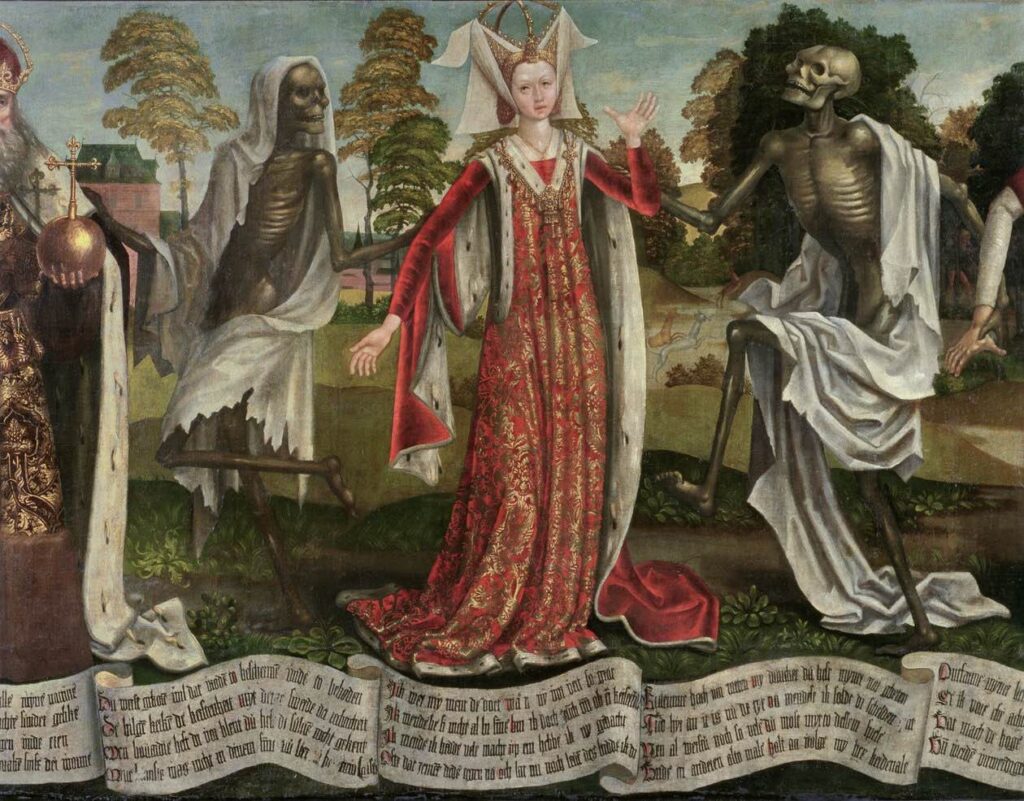
Danse Macabre (detail) – Bernt Notke
Today, this subject has become taboo. It is difficult to place the blame on one single cause when there are several culprits: from modern secularization to consumer culture, from the sheer number of distractions and stimuli we are exposed to daily to the advancement of modern medicine, which not only reduced mortality rates but also removed death from the home and confined it to a clinical environment.
“…you don’t hear that anymore, do you? Frank peacefully died in his sleep. No, he died in the operating table whilst putting on a new lung.”
— Karl Pilkington
Recently, studies of certain biomarkers to estimate a person’s genetic age have become popular. These studies evaluate numerous indicators such as bone density, telomere shortening, chronic inflammation, among many others. Technological advances in healthcare, especially in genomic and precision medicine, are extraordinary, however, they must be contextualized. It is great to have access to these tools, but they easily become excuses for neglect. A painkiller for a headache caused by hours in front of the television, stomach protectors for unhealthy diets, stimulants to compensate for lack of sleep.
Those who participate in these studies have forgotten how to listen to their bodies, those who spend their lives at the doctor know they are not the embodiment of health. Concern for well-being does not prove ignorance, but familiarity with one’s mistakes. People who neglect their quality of life have resigned themselves to death. Whether this decision was made consciously or unconsciously, the effect is the same.
These words are not judgments. I am aware that many unhealthy choices in our lives stem from impositions or circumstances beyond our control.
Regardless of our life choices, every day we are closer to our final destination. We do not live to die, we die while living.
There is a lack of spirituality in our culture. Death should not be interpreted as a void. By observing nature for just a few seconds, one recognizes a cycle, a closed circle, with no beginning, middle, or end. Those who interpret it as empty or observe it with indifference and contempt must understand that this reflects an inner projection. When that experience of emptiness is accompanied by apathy or disconnection, it may constitute a spiritual or moral impoverishment in relation to life.
Our sense of personal identity distinguishes us from other living beings. However, each of us must understand that God and Nature are not interested in our misery, they are not concerned with our problems or our identities. We must be aware of this and be able to assert and express ourselves despite that impersonality.
We must decide which silences to fill, which noises to filter, which will to impose, which imperfections to accept.
“Wild animals run from the dangers they actually see, and once they have escaped them worry no more. We however are tormented alike by what is past and what is to come. A number of our blessings do us harm, for memory brings back the agony of fear while foresight brings it on prematurely. No one confines his unhappiness to the present.”
— Lucius Seneca
The people who reflect most deeply on death, in a symbolic context, are writers, poets, and philosophers. It falls to this group to demystify the myth of death that has taken root in our society.
Three books that deeply marked me on this subject are Para Sempre by Vergílio Ferreira, Apresentação do Rosto by Herberto Hélder and Húmus by Raul Brandão.
In Húmus, every word is pregnant with meaning. In this fragmented monologue, Raul Brandão constructs a dictionary of death, every term the author employs alludes to that transition and provokes a visceral reaction in the reader. Disgust, bile, bitterness, pain, scream, dream, fear, sacrifice, duty, conscience, these are some of the words used to convey the weight of death. This emotional baggage the author describes stems from the ego, from personal identification with this state of suffering. Consciousness allows us to escape our nature, but in doing so we lose the ability to interpret the signals it sends us. We create a world apart, develop a cancer, the ego grows and corrodes humanity’s connection with the whole.
My interpretation of this work is that death is not a final destination in a person’s life, it’s a companion. It’s the leaf that falls on the ground, the river’s current that wears down the stone, the force of the wind that renews the dust.
“Os túmulos estão gastos dum lado pelos passos do vivos e do outro pelo esforço dos mortos”
“The graves are worn down on one side by the steps of the living and on the other side by the efforts of the dead.”
— Raul Brandão
Today I passed past a metal gate. I felt a nostalgic warmth. I couldn’t immediately tell why. A few steps further, I realized it resembles the gate of the cemetery where my maternal grandparents are buried. I never knew my grandmother, and my grandfather passed away when I was only seven.
Instinctively, the memory of this gate should have triggered a feeling of sadness in me, because of the loss it represents. But, although it was a physical loss, it was a gain in the emotional bond I shared with my grandfather, the values he instilled in me, and above all, the cherished memories of our time together and the ties I formed in his homeland.
Death is a spectrum.
It’s the scent of a newborn baby, it’s wrinkles in the skin. It is a point in the cycle of life, but it does close it. It’s the same heat that decomposes bodies and dries up streams. It’s the sun that makes plants grow, warms our skin, and makes us feel alive. It is fertilizer, it is humus.
Keep it close.
Carry it in your pocket if you feel comfortable, keep it on a leash if you still don’t trust it, let it circle above you like a vulture if you wish to observe it from a distance, but see it in your life.
Try to understand it.
Do not let religion define it for you. Do not let the State, the law, or statistics tell you when it is approaching.
Devote yourself to what you are willing to die for, whether that is your family, your art, your work, a hobby, or your principles. Remember that even if you are alone, you are in good company.
“…a gente precisa de encontrar o seu verdadeiro lugar para morrer. Aí é que se vive.”
“…we need to find our true place to die. That is where we live.”
— Herberto Hélder